Estimated reading time: 14 minutes
The Paradox of Power and Effortlessness
Welcome, fellow Seekers and Wayfinders! This guide reveals the ancient secret of Wu Wei, showing you how to gain true power without burning out. If you find that your constant push for success leaves you tired and stressed, you are likely fighting against your own natural energy and the cosmic current. We will show you how to stop struggling and start aligning with life’s flow to achieve effortless productivity and power.
How can you achieve more by actually doing less? What if letting go of control is the fastest way to real influence? Are you ready to trade exhaustion for effortless power?
Key Takeaways
- Wu Wei for effortless productivity and power teaches you to align with your natural flow rather than force outcomes.
- This ancient Taoist principle contrasts with modern hustle culture, promoting sustainable empowerment over burnout.
- Key practices include following the flow, engaging in mindful presence, and embracing movement arts like Qigong.
- Achieve deeper influence by listening, setting boundaries calmly, and allowing for moments of rest and emptiness.
- Integrate Wu Wei into daily life by accepting reality, creating space for intuition, and acting authentically to reclaim your energy.
The modern Seeker often chases after Empowerment: the strength to steer one’s own life, exert influence, and achieve self-determination. However, this common quest, often characterized by the exhausting ‘hustle’ culture, frequently leads to exhaustion, struggle, and resistance. This is the exact opposite of the principle of Wu Wei and the basics of Taoism.
Therefore, we must ask a critical question: Can the ancient Taoist principle of ‘non-action’ (Wu Wei) truly be a sustainable source for modern personal power and leadership, or is it merely a call to passivity and inaction?
🧘Wayfinder: Empowerment through Alignment

Wu Wei (pronounced ‘woo way’) is a foundational concept in Chinese Taoism. Empowerment, in the context of Wu Wei, is the profound realization that true, sustainable power comes from aligning with your natural disposition and the flow of the situation. Crucially, this is far more effective than trying to force the world to your own rigid will. It is the transition from forced action to effective effortlessness.
📜Unraveling the History and Core Meaning of Wu Wei
Origin: A Path to Peace in Chaos
Indeed, the concept of Wu Wei is inextricably linked to the founding texts of Taoism, particularly the Tao Te Ching by Lao Zi and the writings of Zhuang Zi. The concept emerged during the Warring States period in China, a time of great chaos and political turmoil. In contrast to the Confucian ideal of strict rules and active, interventionist governance, Taoism offered a path to peace through a return to natural simplicity.
Contrasting Interpretations: Action vs. Non-Action
In early Confucianism, Wu Wei referred to the ideal behavior of a ruler: governing by avoiding unnatural or oppressive actions. Significantly, with Lao Zi and Zhuang Zi, it gained the deeper, cosmic meaning of living in unity with the unforced flow of nature, known as the Tao.
Meaning and Purpose: Acting Without Forced Intent
Above all, Wu Wei is not passivity or laziness. It is inspired action that stems from a deep inner balance, comparable to the effortless movement of a trained athlete or a skilled artist.
| Component | Explanation |
| Meaning | Doing through not-doing or Acting without forced intent. It involves acting from spontaneity, instinct, and natural energy (Chi), rather than from the ego or rigid willpower. |
| Analogy | Think of water. Water adapts to every shape, seeks the path of least resistance, and yet erodes the hardest stone. Consequently, it acts ‘without acting’ and is therefore invincible. |

The ultimate goal is to achieve harmony with the Tao—the cosmic order. By living in Wu Wei, you reduce inner and outer friction, struggle, and frustration. As a result, you achieve more with less energy, leading to a state of ‘flow’, inner peace, and profound vitality.
💬 “The Tao never does anything, yet nothing is left undone.” – Lao Zi, Tao Te Ching
🛠️The Three Practices to Achieve Effortless Productivity
Wu Wei is not a simple technique, but a way of life, diligently practiced by cultivating letting go and deep presence. These three practices translate the philosophy into tangible methods for effortless productivity.
1. Following the Flow: Moving with the Current
This is the most direct application of Wu Wei in daily life and for effortless productivity.
- Focus: Stop forcing results or rigidly holding onto fixed plans or patterns. Instead, you must look for the natural momentum or least resistant path in a situation for everybody.
- Practice: Accept a delay, like being stuck in traffic, and use the time to breathe, instead of getting irritated or forcing an impossible way out. Indeed, when you get stuck on a problem, let go for a moment and trust that the solution will appear when your mind relaxes.
- Furthermore, in a project management context, this means stopping work on a task that is clearly hitting a wall and switching to one that has natural momentum. This tactical flexibility is a hallmark of true efficiency, rather than stubborn resistance.
2. Meditation and Presence: Non-Intentional Action
Wu Wei requires us to step out of our compulsive, analytical mind and be entirely present in the now. This is where true effortless productivity begins.
- Focus: Non-intentional action. You concentrate solely on the action itself, without judging, forcing, or trying to change the end result.
- Practice: Perform everyday tasks—like washing dishes, walking, or breathing—with complete attention (mindfulness). Consequently, the action becomes an end in itself, and this undivided presence is the very essence of Wu Wei.
- This daily practice trains your mind to operate from a place of clarity. When a complex decision arises,you respond naturally from this grounded state, making the most effective choice without the friction of overthinking or egoic interference.
3. Movement Arts: Embodiment of Non-Resistance
Eastern movement arts, especially Qigong, are physical embodiments of Wu Wei principles.
- Focus: Acting from the 1st Dantian (belly center) and cultivating relaxation in movement.
- Practice: Practice Chi Kung. These movements are round, fluid, and slow. They are designed to teach you deep lessons about effortless power:
- Go with the flow: The movements are gently rolling and resilient, absorbing the energy of gravity instead of fighting against it.
- Do less to achieve more: Strength is generated not by muscle tension, but by relaxation and the coordination of the entire body, making the movement effortlessly powerful.
⚖️The Critical Difference: Forced Power vs. Sustainable Power
The Western concept of empowerment is often aggressively connected to ambition and constant productivity through sheer willpower. However, Wu Wei teaches us that this common approach is a temporary and highly exhausting source of power. This contrast is vital for understanding why so many modern Seekers suffer from fatigue or face burnout.
| Type of Power | Forced Power (Resistance/Burnout) | Sustainable Power (Wu Wei Empowerment) |
| Source | Ego and External Pressure (Must, prove, compare) | Authenticity and Inner Knowing (Being, following, aligning) |
| Action | Struggling against obstacles; forcefully pushing. | Moving with obstacles; flexibly redirecting. |
| Consequence | Exhaustion, burnout, constant friction, unsustainable output. | Flow, energy conservation, profound influence, effortless productivity. |
Wu Wei is the recognition that the most powerful actions are those that cause the least internal conflict. This is how you reclaim your energy and achieve long-term success.
🔑Key Principles of Wu Wei for Sustainable Empowerment
To successfully apply Wu Wei to your personal and professional life, we must translate the core aspects of non-action into effortless, yet highly effective strategies for influence and effortless productivity.

1. Empowerment through Non-Resistance
The first step toward true empowerment is to stop wasting energy on things you cannot change.
- Acceptance as Starting Point: Wu Wei posits that acceptance of the current reality is not passivity, but the most strategic starting point for any effective action. Without first accepting reality (e.g., a mistake, a setback, or the unwillingness of another), you will always waste your energy fighting against what is.
- The Freedom of Letting Go: You are truly empowered when you release the emotional burden of situations beyond your control. This crucial act of letting go creates the necessary mental space to focus on the small, effective actions that are clearly within your reach.
2. Empowerment through Emptiness

The Tao Te Ching states that the usefulness of a pot lies in its emptiness. This profound concept also applies directly to personal power, leadership, and influence.
- Emptiness in Leadership: The most powerful leader is the one who leaves space for others to act and shine. By not micromanaging every task (a typical form of forced action), you grant autonomy and truly empower your environment. Your true influence stems from your calmness and clarity, not from constant interference or unnecessary input.
- Space for Intuition: By taking pauses—moments of ‘non-thinking’—you give your intuition and creativity the chance to deliver the most correct and effortless solution. This is the fundamental difference between forcing a decision through sheer mental effort and allowing a clear, resonant insight to simply arise.
3. Empowerment through Authenticity
This is the most profound form of Wu Wei empowerment and the source of effortless productivity. It means acting only in a way that resonates with your inner, deepest truth (your personal ‘Tao’).
- Know Your Natural Flow: What comes easily to you? What naturally gives you energy? Empowerment in Wu Wei means proactively avoiding roles or tasks that fundamentally go against your nature and fully investing energy in what you naturally do well.
- Action without Attachment: You become powerful when you act (e.g., start a project, give an opinion) without clinging to the outcome. You deliver the action because it is the right action in the moment, and you leave the result to the universal flow. This strategic detachment makes you invulnerable to failure, because your value is not tied to the specific external outcome.
💡Practical Applications for Effortless Power
Wu Wei empowerment can be applied directly in daily interactions to boost your influence and productivity while reducing friction.
- Effortless Boundary Setting: Instead of aggressively and emotionally defending boundaries (forced action), you state your boundary in a calm, factual manner. The power is rooted in the absolute absence of doubt or internal struggle.
- Influence through Listening: In a debate or negotiation, true influence is often found in absorption (the water analogy). Listen completely without immediately reacting or planning your next rebuttal. By giving the other person space, not seeking to make your point, and not fighting for the last word, you create a dynamic in which your rare, effortlessly placed words carry much more weight.
- The Power of Rest and Emptiness: Don’t completely fill your daily schedule. The most successful and influential people often schedule moments of deliberate rest and emptiness. This is where mental and emotional energy is truly recharged, leading to a natural authority and quiet strength in your active moments.
The paradox of Wu Wei is simple: by letting go of the desperate will to seize power, you find the true, sustainable power of alignment and effortlessness. This is the Taoist secret to long-term success without the cost of burnout.
🌳Practice: Standing in Wu Wei for Inner Stability
This foundational exercise, Zhan Zhuang (Standing Like a Tree), cultivates the emptiness, stability, and non-resistance essential for applying Wu Wei in your life. You learn to be a stable, immovable space, centered in your lower Dantian, preventing you from being swept away in the emotional dynamics of others.
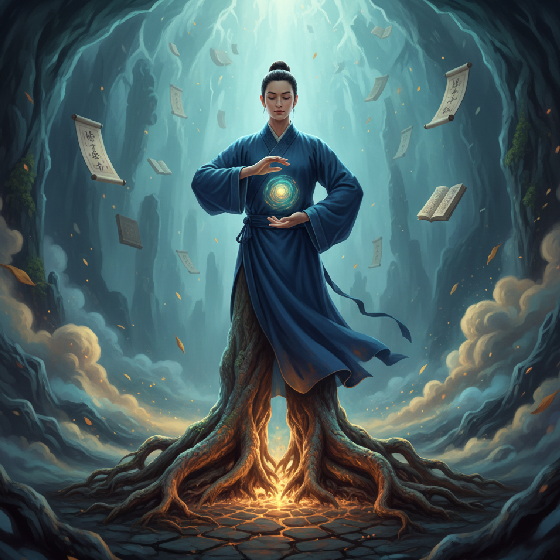
💬 By standing physically still and accepting the posture (non-resistance), you train the mind to remain emotionally still amidst external resistance and unrest.
Goal: Building inner stability and neutrality, allowing you to listen and accept without immediately reacting emotionally or seeking to control any external resistance.
How to Practice Zhan Zhuang
This is the most direct exercise to anchor Wu Wei—action through non-action—in the body. The challenge and the power lie in the apparent simplicity and the immobility and endurance of what is.
- The Base (Feet and Legs):
- Stand upright with feet about shoulder-width (men) or hip-width (women) apart.
- Bend the knees very slightly. Feel as if you are gently sitting on a high stool or chair.
- Distribute your weight evenly across both feet. Visualize your feet as powerful roots growing deep into the earth, linking you to the Tao.
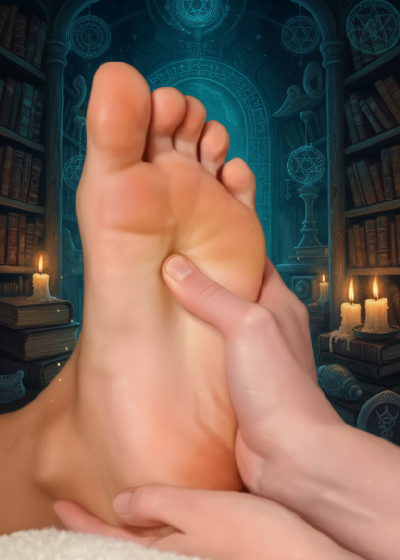
- The focus is on your soles, with attention on your Kidney Point 1 (bubbling spring, see picture). This specific spot is an important ‘grounding point’ for your energy.
- 2. The Center (Spine and Pelvis):
- Keep your back straight. Tuck your chin in slightly, as if balancing a book on your head and as if dangling from a string by your crown.
- Relax the pelvis and lower back. Allow the energy (Chi) to sink to your Dantian (the energy center, about 3 fingers below the navel).
- The Arms (The Embrace):
- Lift your arms to chest height, as if embracing a large, thick tree or balloon.
- The hands and fingers point gently toward each other, but do not touch. The index fingers have a slight, directed tension. The other fingers are relaxed, pointed toward your body.
- Let all tension fall from your shoulders and neck. It is crucial to release tension here to allow the natural flow of Chi.
- The Mind (Wu Wei):
- Look softly at one point, or close your eyes for deeper internalization.
- This is the crucial Wu Wei moment: you do nothing. You do not try to control your breathing; you do not try to tense your muscles; you do not try to think. You are simply focused on what is, without judgment.
- If thoughts or physical discomfort arise, do not fight them. Kindly acknowledge them (“Aha, there is tension…”) and then effortlessly return your attention to your posture and the sensation of your breath.
- Duration:
- Start with 1 to 2 minutes. Gradually build up the time. Remember, the true power of the exercise lies in the consistency and the duration of standing immovably and releasing physical tension and, therefore, your need for control.
🚪Stepping Into Your Effortless Power

We began this journey by questioning the modern pursuit of power—the constant struggle that leads only to burnout. We have now uncovered the profound, ancient solution: Wu Wei for effortless productivity and power.
This Taoist secret is not about doing nothing; it is about discovering your deepest authenticity and aligning your actions with the natural flow of the universe.
When you stop fighting against the current, you achieve more, not through brute force, but through pure, sustainable alignment.
🔑 Key Takeaways on Wu Wei
To immediately integrate this powerful principle into your life, remember these three core tenets of effortless power:
- Stop Fighting Reality (Non-Resistance): True empowerment begins with accepting what is—a mistake, a setback, or a difficult situation. Energy wasted in fighting reality is energy lost. Acceptance is the most strategic starting point for effective action.
- Make Space (Emptiness): The most powerful leaders and thinkers create pauses and space in their schedules and minds. This emptiness is where intuition and creativity arise, leading to solutions that are effortless rather than forced.
- Act from Authenticity (Natural Flow): Avoid roles or tasks that drain you. Invest your energy in what comes easily and naturally resonates with your inner truth (your personal ‘Tao’). This is the true source of effortless productivity.
🌟 Further Your Journey
The transition from the stressful ‘hustle’ to the peaceful ‘flow’ is the most powerful choice you can make for your mental health and your success. Healing is a collaborative process; if you’re looking for direct support, my Professional Therapy and Astrology rates are available here.
- Practice: Commit to the Zhan Zhuang (Standing Like a Tree) exercise daily to physically anchor the principles of stillness and non-resistance.
Embrace the paradox: True power lies in letting go!