Estimated reading time: 15 minutes
Welcome, Seekers & Wayfinders! This guide will teach you the ancient secret of the Inner Smile, a simple, yet profound, way to feel calm and strong inside. You’re always busy helping others and solving big problems, but what about your own stress? Too much worry or frustration makes your body tired and tense. This simple, silent practice stops that internal stress before it starts. Are you ready to find the hidden power in your own kindness? What if the easiest way to feel better was just to smile toward yourself? It’s time to claim your inner peace.
Key Takeaways
- The Inner Smile is a transformative Taoist practice that promotes calmness and strength through self-kindness.
- It involves generating feelings of love and gratitude, sending this energy throughout the body to heal and relax.
- Practicing the Inner Smile helps dissolve negative emotions stored in organs, improving emotional and physical health.
- The technique connects your three treasures: Jing, Chi, and Shen, boosting overall vitality and self-awareness.
- Consistency in practicing the Inner Smile leads to personal growth and empowerment, making it a vital tool for modern stress management.
Taoism, an ancient Chinese philosophy and tradition, offers profound insights into cultivating a harmonious life. One of the most loving and powerful techniques within this tradition is the Inner Smile. This is not a physical grimace, but a profound meditation practice used to relax the body, calm the mind, and heal and strengthen the life force (Chi).
You are the Hero on a Quest, but you are so focused on slaying the dragons of others that you forget to claim the treasure in your own inner world.

What if I told you that the most powerful transformation begins with something as simple as… the feeling of smiling toward yourself? This is the first ‘aha’ moment: you realize that the source of true empowerment lies not in solving external problems, but in the kindness with which you approach your own being. Today we begin the journey to discover that smile, relax the body, calm the mind, and heal and strengthen the life force (Chi).
1. Defining the Inner Smile: A Revolutionary Act of Self-Care
The Inner Smile is not just a feel-good concept; it is a revolutionary act of self-care and one of the first, crucial steps on your path to personal growth and self-awareness.
Specifically, it is a method in which one intentionally generates a feeling of love, gratitude, and acceptance, and then systematically sends this ‘smiling’ feeling throughout the entire body.
The Taoists believe that the smile is the most powerful universal energy field. By smiling internally, you send positive, healing energy to the organs, glands, and nerves. This stands in sharp contrast to negative emotions, such as fear, anger, or stress, which, according to Taoist teachings, constrict, heat, and ultimately damage the vital organs.
➡️ Taoist Principle: An organic system flooded with loving, relaxed energy will function optimally, while a system under stress will stagnate and weaken. Therefore, consistent practice is key to vitality.
The Core of Taoism: Harmony, Wu Wei, and Cultivating Chi
The concept of the Inner Smile aligns perfectly with the core principles of Taoism:
- Harmony and Balance (Yin and Yang): The practice aims to transform emotional and physical disharmony in the body into balance and tranquility, the essence of the Tao (The Way).
- Action Through Non-Action (Wu Wei): Instead of fighting negative emotions or physical tension, you approach them with gentle acceptance and love (the smile). Consequently, this is a form of ‘acting without effort,’ activating the body’s natural self-healing capacity.
- Cultivating Chi (Life Energy): The smile is an instrument to soften the Chi and allow it to flow freely. Stagnation of Chi is seen as the cause of imbalance and ultimately illness. In addition, by the warm feeling of smiling, the flow is promoted, leading to greater vitality.
The Inner Smile Technique: A Step-by-Step Guide
How to practice the Inner Smile involves focusing attention on the internal structures, starting at the source of the energy (the connection of the three treasures) and then descending wherever you wish.
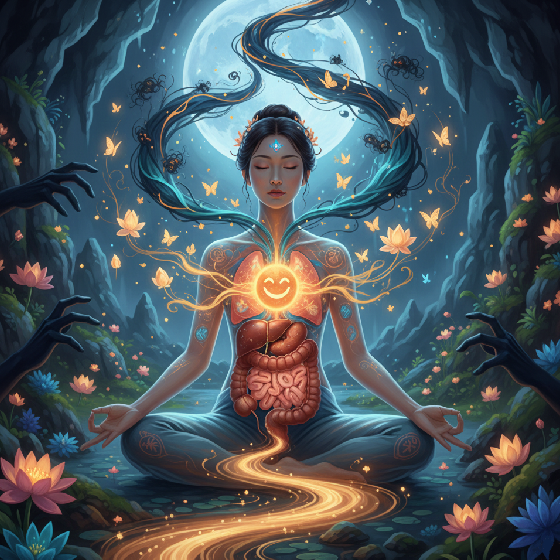
- The Viewpoint (Start): The smile often begins by softening the eyes, the ‘gates of the soul,’ and is experienced as a warm, gentle radiance. Through this softening, your view of the environment changes. Just think about how you feel when your eyes look at a newborn baby or a nest of puppies or lambs in the spring meadow.
- The Path (Descent): From the eyes, the smile is sent through the brain (Shen) and the face to the glands (such as the pineal and pituitary glands). To illustrate, soften your face and daily mask and move into silence, which supports hormone balance.
- The Connection (The Three Treasures): The intention of the smile then descends from the 3rd Dantien (Shen), bringing the silence down to the 2nd Dantien (Chi), and carrying consciousness and silence through to the 1st Dantien (Jing). The Inner Smile is the connection of the three treasures. The moment the three treasures are connected with this intention, you are in the “Inner Smile” mode and can direct this feeling anywhere to allow the Chi to flow.
- The Organs (Healing Focus): For example, the Inner Smile can be directed one by one to the vital organs (lungs, heart, liver, spleen, kidneys, and even sexual organs). This is a crucial step, as each smile is aimed at neutralizing the specific negative emotion attributed to each organ (e.g., anger for the liver, fear for the kidneys). This is often referred to as Taoist organ healing.
Storing Your Energy: The Microcosmic Orbit
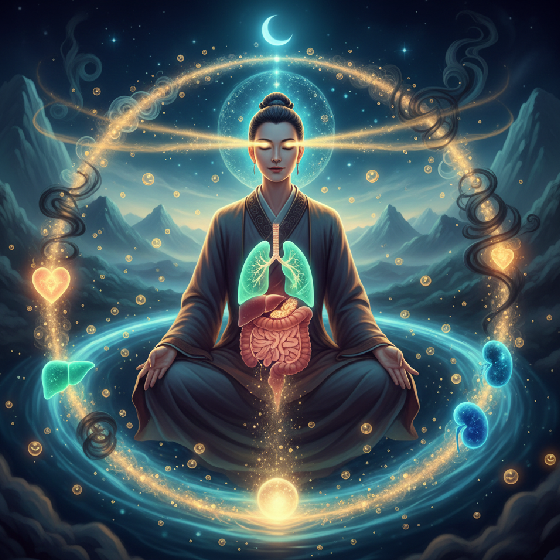
The final and essential step in how to practice the Inner Smile is the completion phase. The smile is finally sent through the spine, the nervous system, and the limbs and ‘stored’ in the Dantien, the energy center below the navel, through the Microcosmic Orbit. This process circulates the newly generated, purified energy throughout your system, ensuring that the healing benefits are retained and accessible.
Essential Benefits: Why the Inner Smile is Perfect for the Modern Person
In our fast-paced, stressful society, the Inner Smile is an extraordinarily practical tool for mental health:
| Benefit | Explanation |
| Stress Reduction | The practice activates the parasympathetic nervous system (rest and digest), switching off the ‘fight-or-flight’ response. Therefore, it’s a direct antidote to modern stress. |
| Organ Support | It cultivates a state of deep relaxation around the organs, improving their blood supply, digestion, and detoxification processes. |
| Emotional Transformation | It teaches you not to suppress negative emotions, but to gently convert them into acceptance and virtue, particularly gratitude and love. This is central to effective emotional healing. |
| Increased Vitality | By allowing the Chi to flow more freely, practitioners often experience an increase in energy and a strengthening of the immune system. It’s a natural energy boost. |
In short, the Inner Smile is a simple, silent, and deeply transformative practice. It teaches us the power of internal kindness as a foundation for health and spiritual growth, making it not just an exercise, but a way of life in accordance with the Tao.
2. Understanding Chi Stagnation: How Emotions Get Stored in the Organs
Within Taoism, the body is not merely an outer shell as we know it; it is a microcosm, a landscape full of rivers of Chi (life energy) and mountains of stored emotions. The Inner Smile is a fundamental and indispensable meditation technique in almost every Chi-Kung style, but within Nei Dan Gong (Internal Elixir Work), it is elevated to a refined alchemical art.
Why is this so relevant to you, the Seeker & Wayfinder who struggles with stress, health issues, or love?
The Taoists understood something crucial about mental health and stress. They taught that negative emotions—such as worrying, anxiety, anger, or loss of control—do not just disappear into the air; they are stored in the vital organs, causing the flow of Chi to stall, making life feel exhausting and draining energy. For instance, the Liver becomes tense from frustration, the Kidneys from fear, and the Spleen and Stomach from excessive worrying and organizing. Your body is stuck in the ‘always on’ mode.
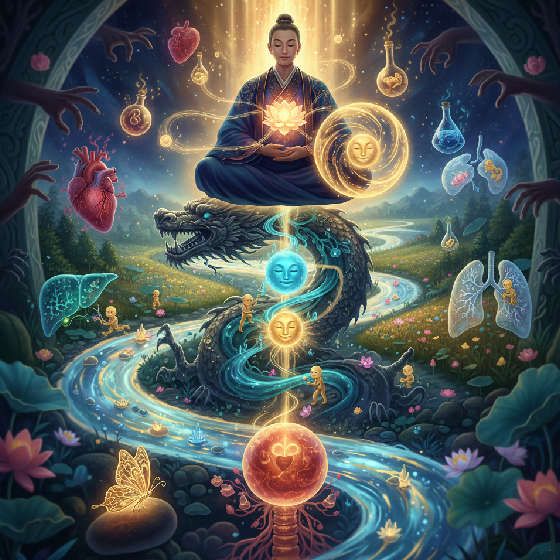
The Body as a Microcosm: Linking Emotions to Organ Health
The Inner Smile is the gentlest, most effective way to dissolve this emotional stagnation. It is the art of purposefully cultivating positive and relaxing feelings. By directing your energy inward and consciously smiling at your organs, you not only bring about relaxation but also generate a powerful healing Chi that ‘washes’ the tense organs. This is an active form of self-awareness and consciousness in action. You strengthen the contact with your authenticity and can and dare to follow your unique flow.
Key Difference: The smile you give to the outside world to keep things going is only a mask, a shadow, and cannot compare to the incredible healing power you can unleash when you send a truly sincere smile inward. The power of this technique lies in its focused, internal kindness.
3. How to Practice the Inner Smile: Detailed Organ Meditation
This section provides the detailed steps on how to practice the Inner Smile specifically for targeting and transforming emotional blockages in the vital organs, which is a key differentiator of the Taoist technique.
The Three Treasures Connection: Jing, Chi, and Shen in Practice
The foundation of this deep practice involves connecting the three main energies:
- Physical Energy (Jing): By starting the smile from your eyes and letting it flow as a warm stream to your brain and as a waterfall along your face, neck, and chest, you signal to your nervous system: ‘Safety. Relax.’ This is a direct reset of your fight-or-flight response. You literally feel the muscles in your jaw, shoulders, and abdomen (where we often hold ‘control’) let go.
- Emotional & Mental Energy (Chi): The smile is then specifically guided to the organs for deep emotional clearing, which is a key part of how to practice the Inner Smile for maximum benefit:
- Lungs (Courage & Righteousness): You smile to soothe grief and melancholy, renew the energy of the Chi, and feel that you are worthy of the air you breathe and literally stimulate space.
- Heart (Love & Joy): You smile at your Heart to soothe haste and anxiety and stimulate respect. The heart is the seat of the Shen (Spirit). Therefore, cultivating joy here stabilizes your entire being.
- Liver (Kindness & Patience): You smile to soothe frustration and the urge to control everything and stimulate kindness.
- Spleen/Stomach (Fairness & Honesty): Here you smile to release the constant worrying, organizing, and the tendency to worry too much about others, and to stimulate rest and balance.
- Kidneys (Gentleness & Calmness): You smile to relieve the deep, lingering fears and the feeling of overwhelm and stimulate joy, pleasure, and innocence.
Transforming Worry into Power: The Spleen’s Role
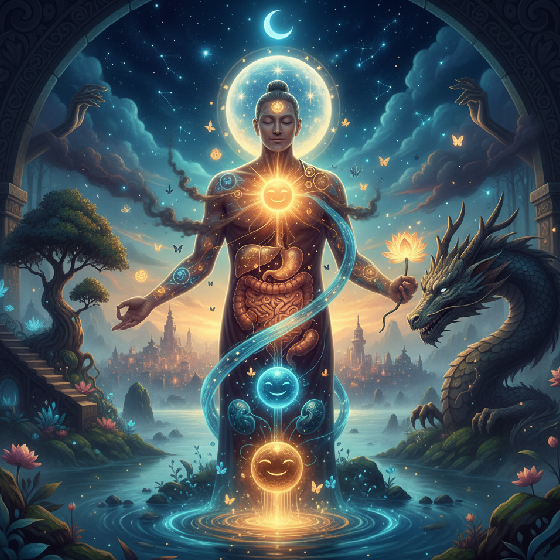
Here is a twist that you, as a Wayfinder, will recognize: your tendency to worry and multitask is, in fact, your talented but overworked Spleen energy. Your Spleen wants to nourish you, organize you, and give you the foundation. But when it works too hard for everyone but yourself, it becomes exhausted, and the care becomes a worry.
- In Practice: Imagine you just got home from a day full of meetings and helping others. Instead of immediately starting dinner or planning for tomorrow, take two minutes. Close your eyes. Breathe. And smile internally at your Spleen and Stomach, saying: “Thank you for all your hard work. You can rest now.” This is an act of empowerment – you take control of your own internal energy, instead of letting it be determined by external chaos. This is a crucial element of how to practice the Inner Smile as a daily self-care ritual.
4. Mastery Through Wu Wei: Softness vs. Willpower in Self-Healing
The Inner Smile is the embodiment of the Taoist principle of Wu Wei (Non-Action or Acting without Forcing), but on an emotional level.
In Taoism, the ideal state is the naturalness and softness of flowing water. Consequently, the stream of water does not try its best to bypass the stone; it is the path of least resistance. You are often prone to over-action and over-control, especially in a helping or creative profession. You try to solve problems with your willpower.
The smile, on the other hand, is Wu Wei: it is the gentle force that loosens the knots of stress and worries in your organs, without forcing.
Real-Life Application: Love, Work, and the Wayfinder’s Journey
Understanding how to practice the Inner Smile is about integrating this gentle force into your daily challenges:
- Love and Relationships: You are the partner who always tries to organize and maintain harmony (Physical: Tension in the Spleen/Stomach). This feels like love to you, but it leads to exhaustion. Aha-Moment: Instead of ‘fixing’ the relationship, you smile at your Heart. You fill your own tank with love, allowing you to react from abundance instead of scarcity. You become a source, not a solver.
- Work and Career: You are quickly frustrated by injustice or slow processes; you feel the urge to push too hard (Physical: Stagnation in the Liver). This leads to a short fuse. Aha-Moment: You learn to smile at your Liver. You choose to cultivate kindness and patience, which gives you the wisdom to see when you should act, and when you should let the situation ripen with gentleness. This is the difference between working hard and being in your power.
Beyond Relaxation: Accelerating Personal Growth with Nei Dan Gong
Nei Dan Gong teaches you to convert the energy released by the relaxation of the smile into clarity and deeper insight into your life path. Your personal growth accelerates because you are no longer held back by unprocessed emotions stuck in your organs. You are no longer a caretaker of the world, but a master of your own energy.
5. The Mirror of the Self: Deepening Consciousness and Setting Boundaries
The Inner Smile is the key to understanding the deepest layers of Chi-Kung and Taoism.
You have now reached the point where you realize that the Quest you are undertaking is not about finding a map or a magic object or a Quick fix, but about making your own energy whole. Therefore, the smile is the opposite of worry and control. It is trust in the process of life.
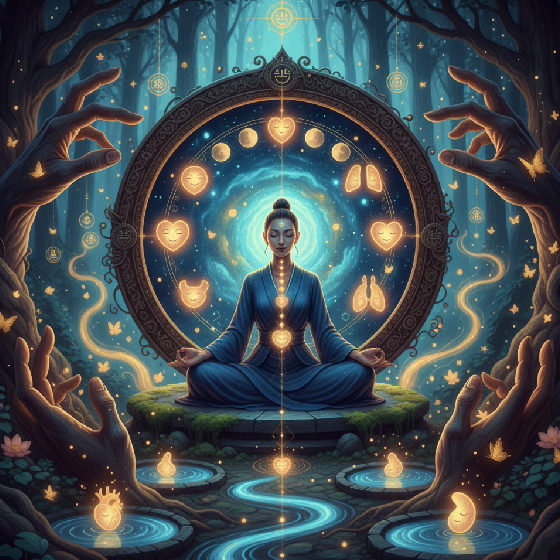
The smile, in the Taoist sense, is your most fundamental act of self-awareness. It is the recognition: “I am here, I feel this, and I am kind to this part of myself that is asking for attention.”
Practical Examples: Finding Courage and Setting Boundaries with the Smile
This is the power of using the Inner Smile for emotional healing in real-time:
- Boundary Setting: When you feel the urge to say “yes” when you mean “no,” stop for a moment and smile at your Heart and Spleen. You create the space to feel, which allows you to find the courage to set boundaries. This is empowerment through internal awareness.
- Nighttime Anxiety: When you wake up from a stressful dream about organizing or multitasking, you smile at your Kidneys, and you replace the fear with gentle, watery calmness.
- Dealing with Anger: When you feel frustration bubbling up (often a sign of an overactive Liver), you pause, exhale fully, and send a deep smile into your right side, cultivating patience and kindness instead of reaction.
All this is an exercise in raising your consciousness and specific exercises can suppport these organs/meridians. You learn that you are not your worries; you are only suffering from an overzealous part of your internal system that needs a smile to calm down. This perspective gives you the deeper insights and personal growth you long for. You are the Hero who defeats the dragon of inner unrest with the softness of a smile.
6. Conclusion: Consistency is the Key to Claiming Your Inner Path
Seeker, you now hold the most powerful, most simple technique to continue your journey. The Inner Smile is your shield against stress, your lamp on the path of self-awareness, and the fastest way to personal growth.
The key is consistency. Start today, now, with one smile to your Heart and one to your Spleen. Give your Spleen the rest it deserves after all that worrying and organizing.
Your Most Important Lesson: The Softness of the True Master
Key Takeaway: The true master of Chi-Kung is not the one with the most muscle power, but the one who can cultivate the softest kindness for their own internal landscape. Your empowerment begins from within.
Ready to dive deeper into the transformative power of Nei Dan Gong? Read more about the 3 physical blocks that stop your energy!
Join our growing community of Seekers & Wayfinders! Subscribe to our newsletter for the latest Chi-Kung lessons and personal health-related articles, or subscribe as a member to learn the visualizations and exercises of the Inner Smile.
Take the first step: Smile 🙂 The journey awaits you!