Estimated reading time: 11 minutes
Hello, brave Seekers and wise Wayfinders! Today, we delve into the intriguing connection between procrastination and mental health.
Welcome to your sanctuary. This article is your comprehensive guide to understanding the profound connection between procrastination and mental health. We often view delayed tasks as simple laziness or poor time management. However, we know that avoiding tasks leads to a heavy burden of guilt, stress, and self-doubt. Consequently, this steals your inner peace and clouds your life path.
Are you tired of feeling like you are constantly fighting yourself? Do you want to finally unlock the secret to stopping the exhausting cycle of “I’ll start tomorrow”?
Key Takeaways
- Procrastination often stems from emotional struggles, not poor time management, impacting mental health significantly.
- The article explores the battle between the Prefrontal Cortex and the Limbic System in the brain during procrastination.
- Cognitive distortions like all-or-nothing thinking and catastrophizing fuel procrastination, leading to irrational avoidance.
- The Four Archetypes of Procrastination highlight different styles, each with unique impacts on mental health and personal growth.
- Balanced action can reduce anxiety and improve mental well-being by fostering self-trust and deeper connection to purpose.
Do you ever find yourself staring at a blank screen? Perhaps you feel a heavy mix of guilt, anxiety, and a bewildering inability to start that one important thing. You are not lazy. In fact, you are likely over-achieving in three other areas of your life. This isn’t a failure of will. Rather, it is a symptom of a deeper, unexamined truth on your journey.

Therefore, this article shines a light on how procrastination is actually a signpost. It points you toward greater self-awareness and profound mental well-being. I believe that when you understand this roadblock, you can transform it. You can turn a paralyzing threat into a powerful tool for personal growth. Today, we will see procrastination and mental health not as enemies, but as messengers. Let’s decode the message and set you back on your quest.
The Science: What Procrastination Does to Your Brain
My seekers often describe procrastination as a “time-thief.” But let’s look closer at the biology of this Hero’s Journey. The task you are avoiding isn’t the problem. Instead, it is the emotional experience of the task that causes the delay.
In the language of psychology, procrastination is fundamentally an emotion-regulation strategy. Yep, you read that right. It is not a time management issue. It is an emotion management issue.
The Battle: Limbic System vs. Prefrontal Cortex
Inside your brain, an ancient battle is taking place. On one side, you have the Prefrontal Cortex. This is the “wise leader” of your brain. It handles long-term planning, your life path goals, and willpower. It knows that finishing that report will make you feel good next week.
On the other side, you have the Limbic System (specifically the Amygdala). This is the primitive, emotional part of the brain. It is concerned only with immediate survival and pleasure. It wants to feel safe right now.
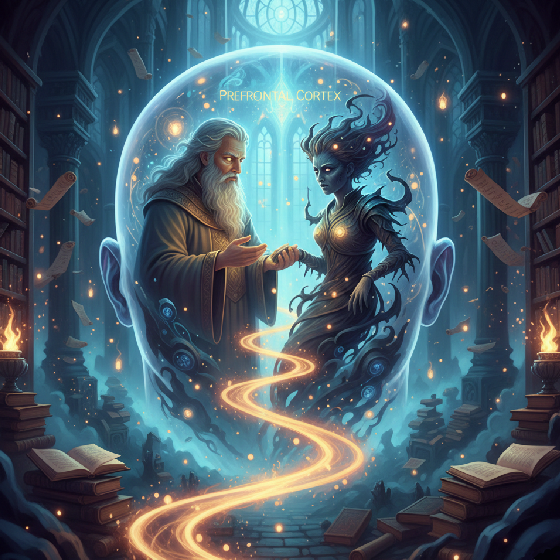
When you think about a stressful task, your Amygdala perceives it as a threat. It screams, “This is scary! This might fail! Run away!” To protect you from this pain, your mind throws up a distraction. For example, you might scroll through social media or suddenly decide to clean the refrigerator. This creates a temporary hit of dopamine.
However, this choice is a high-interest loan. You get immediate relief. But you pay for it later with compounded guilt and stress. This significantly chips away at your overall mental well-being. The real consequence of chronic procrastination is the erosion of self-trust. It creates a negative feedback loop. Avoidance leads to poor results. Then, this leads to more anxiety about the next task. Therefore, breaking this cycle requires not more discipline, but deeper compassion.
The Mental Traps: Cognitive Distortions That Fuel Delay

To truly understand procrastination and mental health, we must look at the stories we tell ourselves. In Cognitive Behavioral Therapy (CBT), these are called Cognitive Distortions. These are irrational thought patterns that convince you that avoidance is the only safe option.
Recognizing these traps is the first step to disarming them. Do you recognize any of these whispers on your journey?
1. All-or-Nothing Thinking
This is the belief that if you cannot do something perfectly, there is no point in doing it at all.
- The Trap: “I only have 30 minutes, but I need 3 hours to finish this. So, I won’t even start.”
- The Reality: This binary thinking freezes you. It ignores the value of progress. In reality, writing one messy paragraph is infinitely better than writing nothing.
2. Catastrophizing
This occurs when your mind immediately jumps to the worst-case scenario.
- The Trap: “If I write this email and it sounds stupid, my boss will think I’m incompetent, and I might lose my job.”
- The Reality: Your brain is treating a minor discomfort (writing an email) as a life-or-death threat. This floods your system with cortisol, making it physically difficult to focus.
3. Emotional Reasoning
This is the false belief that your feelings are facts.
- The Trap: “I feel scared and overwhelmed; therefore, this task must be dangerous or impossible.”
- The Reality: Feelings are transient weather patterns, not the truth of the landscape. You can feel fear and still be capable of taking action.
4. Low Frustration Tolerance
This is the mindset that you should not have to do things that are boring, difficult, or uncomfortable.
- The Trap: “This is too hard. I shouldn’t have to struggle this much. I’ll do it when I feel more ‘in the flow’.”
- The Reality: “The Flow” is a reward for starting, not a prerequisite. Waiting for it is a guarantee of stagnation.
The 4 Archetypes of Procrastination
On your journey, it helps to identify exactly what kind of “avoidance monster” you are fighting. Researchers and psychologists have identified several styles of procrastination. Which one resonates with you?

1. The Perfectionist
The Motto: “If I can’t do it perfectly, I won’t do it at all.”
The Fear: You are terrified of judgment or making a mistake. You equate your self-worth with your output.
Impact on Mental Health: This leads to high anxiety and burnout. You spend more time worrying about the quality than doing the work.
2. The Dreamer
The Motto: “I’ll do it when the vibe is right.”
The Fear: You fear the drudgery of details. You love the idea of the project but hate the structure required to build it.
Impact on Mental Health: This leads to a sense of unfulfilled potential and depression. You see grand visions but feel incapable of manifesting them.
3. The Worrier
The Motto: “What if something goes wrong?”
The Fear: You seek safety above all else. You avoid tasks because they force you out of your comfort zone.
Impact on Mental Health: This is closely linked to Generalized Anxiety Disorder. The unknown feels dangerous, so you stay frozen.
4. The Crisis-Maker
The Motto: “I work best under pressure.”
The Fear: You fear boredom or lack of stimulation. You wait until the last minute to get an adrenaline rush to force you into action.
Impact on Mental Health: This creates a cycle of cortisol spikes (stress hormones). Eventually, this adrenal fatigue leaves you exhausted and depleted.
The Psychology of Action: Balanced vs. Imbalanced Energy

In the world of personal growth, we can view action—the opposite of procrastination—as an energy. Your goal as a Wayfinder is to cultivate the balanced expression of this energy.
When we operate from a balanced place, our action energy helps us prioritize. We move forward with clarity. When we are imbalanced, this energy turns into paralysis. Or, it becomes “pre-crastination,” which is frantic, non-essential busywork.
Here are five reasons why focusing on balanced action is crucial for your mental well-being:
- Reduced Anxiety and Stress: When you take balanced action, you replace the vague spectre of the task with concrete steps. This shifts your nervous system out of “fight or flight.” Research shows that self-efficacy—the belief in your ability to succeed—is a powerful buffer against anxiety disorders.
- Increased Self-Trust: Every time you keep a promise to yourself, you deposit a coin of trust into your bank. This foundation is essential for deep inner peace. Chronic procrastination creates internal conflict and self-criticism. These are two major drivers of low mood.
- Enhanced Creative Flow: Many creative professions struggle with the pressure of the “perfect” first step. Balanced action means embracing “good enough” to get the engine running. An imbalanced approach often manifests as paralyzing perfectionism.
- Improved Physical Health: The cortisol constantly released when you avoid an important task takes a physical toll. Imbalanced action leads to chronic inflammation. Cultivating balanced action lowers stress levels and supports long-term health.
- Deeper Connection to Purpose: Procrastination is often a defense against growth. Balanced action means accepting discomfort as part of the Hero’s evolution. When you avoid the challenge, you stagnate. When you meet it, you experience true alignment with your life path.
Overcoming Avoidance: Tools for the Hero
Let’s zoom out, Wayfinder. In the day-to-day, procrastination isn’t just about avoiding a task. It is about avoiding being the person who can handle that task. How do we shift this? We need practical tools to hack the brain and soothe the spirit.
The “Two-Minute Rule” for the Worrier
If a task takes less than two minutes, do it immediately. But here is the deeper hack: If a task takes hours, just do the first two minutes. Tell your brain, “I will just open the document and write one sentence.” This lowers the threat level in the Amygdala. Usually, once you start, the fear vanishes.
“Time Boxing” for the Dreamer
The Dreamer hates indefinite structure. So, create a container. Decide exactly when you will work on the task (e.g., “I will work on Chapter 1 from 9:00 AM to 9:30 AM”). Do not focus on finishing the chapter. Focus on filling the time box. You conquer the time, not the task.
“Shadow Work” for the Perfectionist
This is a spiritual tool. When you feel the urge to delay, pause. Take out your journal. Ask yourself the uncomfortable questions:
- What exactly am I afraid will happen if I finish this?
- Whose voice am I hearing that tells me this isn’t good enough?
- What is the worst-case scenario, and can I handle it?
Bringing the shadow fear into the light often dissolves its power.
Visualizing the “Future Self”
Procrastination disconnects you from your future self. You treat “Future You” like a stranger who has to deal with your mess. Close your eyes. Visualize yourself next week having completed the task. Feel the relief. Feel the pride. Connect emotionally with that version of yourself. This builds empathy and motivation to act now.
A New Chapter Begins: Claiming Your Inner Peace
Wayfinder, your quest is not to eliminate procrastination entirely. Because we are all human, we will all falter. Your goal is to decrease its frequency and duration. You must learn to understand its messages.
By viewing procrastination and mental health as deeply connected, you stop fighting yourself. You start listening to yourself. This is the path to sustainable inner peace.
We have uncovered the deep connection between avoided tasks and avoided emotions. You have learned that balanced action is the wellspring of empowerment. Every time you gently steer yourself away from distraction and toward a small step, you are writing a new narrative. You are choosing self-trust over short-term relief. You are choosing personal growth over stagnation.
Key Takeaways for Your Quest:
- It is Emotional, Not Logical: Procrastination is an emotion-regulation strategy. It is the avoidance of discomfort (anxiety, fear, boredom).
- Watch Your Thoughts: Be aware of “All-or-Nothing” thinking. It is a trap that keeps you stuck.
- Action Creates Motivation: Do not wait to feel ready. Motivation follows action.
- The Biggest Picture: Your quest is to align your actions with your values. When you procrastinate, your actions and values are in conflict. Resolve the conflict, and you unlock your true empowerment.
The journey continues. The world needs the balanced, authentic, and whole version of you!
Do you want to continue receiving powerful insights like this to help you navigate your life path? Join our community today for the latest articles on mental health, self-awareness, and personal growth where we transform these insights into actionable daily strategies. Honor your inner light by investing in a Professional Coaching or Astrology consultation. Let us guide you further on your path to mental well-being and inner peace!